DAS Orientation for Architects & Builders
To learn more about what a Public Safety DAS (ERRCS) is and what its components are please see our Public Safety DAS page. Below Detailed review of components of a DAS system assumes you are already aware of what an ERRCS System is and what it consists of.
A DAS Orientation for Architects:
Our Public Safety DAS page offers an overview of what a DAS system is. The purpose of this section is to help architects understand best practices is allocating head-end space,, riser point, required assemblies, and hallway soffits allowances that reduce costs to both the DAS vendor and builder.
Head-end & Riser Considerations:
The head-end system must be wired directly to the rooftop antenna that receives and broadcasts signal from and to the fire department’s signal source for the community. Head-end system also connects to interior antennas on various levels, antennas that behave like WiFi access points providing two-way wireless connection between a radio user, the radio system [head-end] and the Fire Department. Both connections are referred to as the Vertical Pathway and wiring for both connections must be enclosed in 2” EMT conduit enclosed in a two-hour rated assembly.
The most cost effective solution would be to minimize the amount of required rated assembly. In small to medium size projects [typically under 300,000 Square Feet] there is typically one vertical riser that extends to upper floor antennas and to the roof-top antenna [known as Donor]. In larger buildings or buildings split into two split structures on the same podium there may be additional risers and those risers also require conduit within a rated assembly. The most cost effective head-end location would minimize the distance between the head-end and the riser. Since almost all staircases are two-hour rated, placement of the head-end next to staircase eliminates the rated assembly required, both vertically and horizontally. Note that in California wiring for fire systems may be run within staircases; therefore eliminating the cost of the rated assembly.
The second most important consideration for a head-end location is which side of a building it needs to be on. Note that the roof-top antenna that communicated with the Fire Department should be installed on the outer edge of the building facing the Fire Department signal source. The antenna cannot face any section of the roof-top, nor can it face another building blocking its view. If a riser terminates on the rooftop away from the edge facing Fire Dept signal source, then it must be extended by conduit to that edge. Therefore, the optimum choice for a head-end is next to a stair case that terminates on the rooftop most closely to the edge facing Fire Dept signal source. If you do not know the location that signal source, a DAS vendor can determine that if given the address. Alternatively, the Fire Dept for that community can also provide this information.
The last items to consider is the type and size of a DAS closet or wall space. A single structure under 300,000 SF may require a single head-end and therefore the following provisions will suffice
- A 2-hour rated closet or wall space in 2-hours rated room providing floor to ceiling clearance and 42” wide wall space.
- Provide a dedicated 20-amp circuit at DAS closet with its own ground and extended that ground to Ufer Grounding via a number 2 awg ground wire.
- Provide weatherproof AC and EPO Lock out in same DAS closet.
- Smoke detector and sprinkler in DAS closet/area
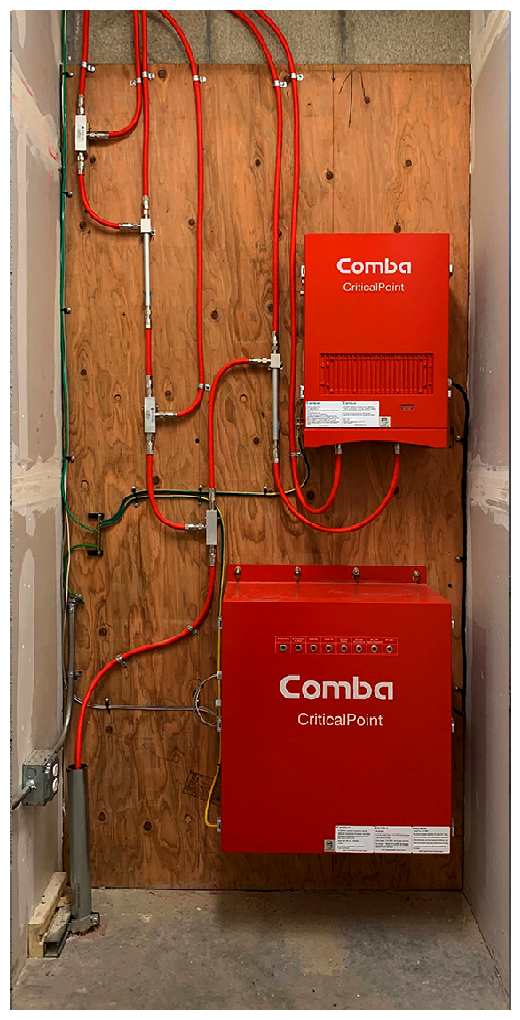
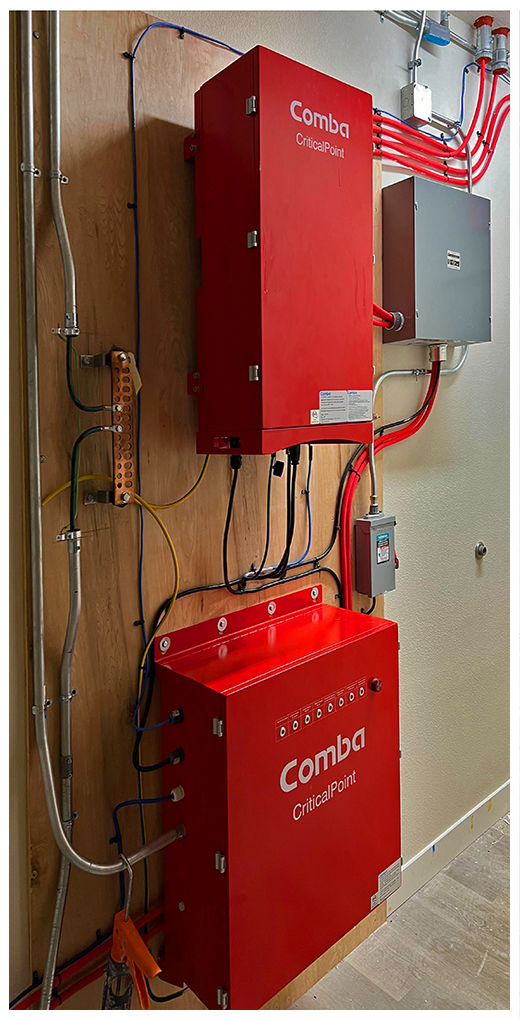
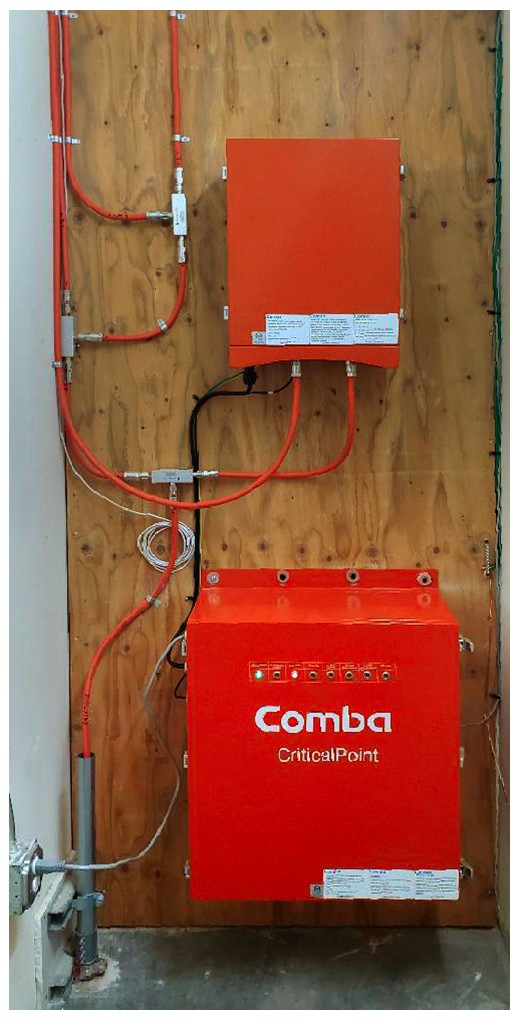
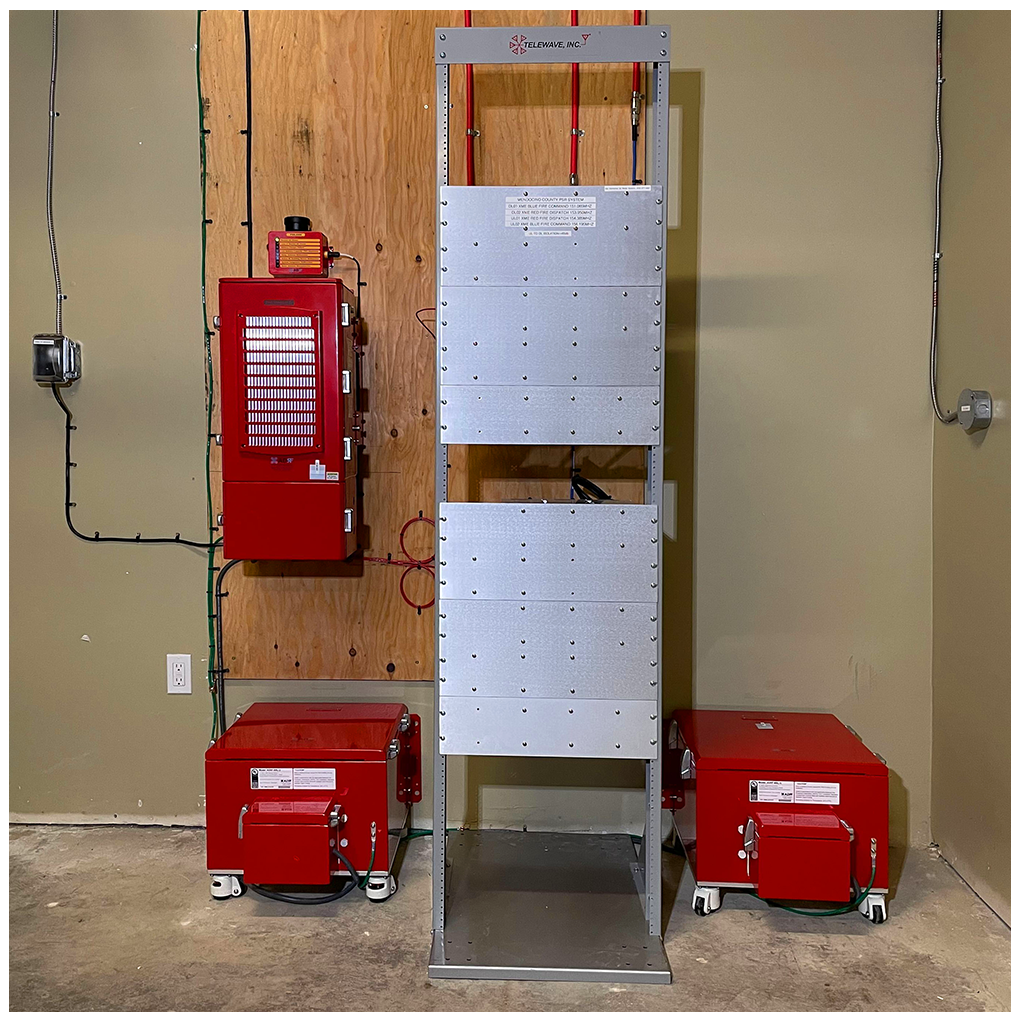
Note that some communities Fire Department of the responsible County Fire Department use odd frequencies that may require a secondary radio and on occasions a filtering system enclosed in a large floor standing chassis. Below photos illustrate various head-end equipment setups in which we have installed DAS systems and as you can see bottom set of photos show a larger system requiring a space twice as large with more power requirements and lock out switches.
Multi-Structure DAS Systems:
Multi-structure projects may require secondary DAS head-ends in the other structures. Multiple structures at a singular address should be interconnected with coaxial or fiber cabling. Therefore a dedicated conduit between main and secondary structures will be required. However, only the main building will require a connection to the rooftop. Before deciding which building should have the main/master system head-end with a riser to the rooftop, a DAS engineer should examine the site plan and decide which building faces directly at the Fire Dept signal source. Note that both the main system and its remote sub-systems will require the same provisions for power, grounding, smoke detector and weatherproof AC and EPO lock outs.
DAS Provisions in Residential Level Dropped Ceilings:
City of Los Angeles Fire and a few other Southern California communities do not require DAS related wiring on residential floors to be in conduit; that applies only the vertical riser and parking levels. However, multiple AHJ are requiring all DAS wiring to be enclosed in EMT conduit on all levels. As of now, this is true in Glendale, Pasadena, Burbank, Monterey Park, and all areas within the jurisdiction of LA County Fire. Conduit provisions on residential floors require dropped ceilings with sufficient clearance to run 1.5” and 2” EMT conduit.
A DAS Orientation for Builders:
To learn more about what a Public Safety DAS (ERRCS) is and what its components are please see our Public Safety DAS page. Below Detailed review of components of a DAS system assumes you are already aware of what an ERRCS System is and what it consists of.
Components of a DAS system a Builder is responsible for:
Not all AHJ interpret the national set of codes related to this provision the same way. Even within the same AHJ, different inspectors interpret some of the requirements differently. This is mostly due to the fact that most AHJ have only recently adopted this mandate, and it will take time for all their staff to acquire the orientation needed to adopt a consensus as to what the requirements mean. We know this because frequently fire department officers are in some of training we are invited to by manufactures of DAS components. Moreover, over the past several years we have seen more and more cities converge on similar interpretation with greater consensus on these requirements. Based on our experience, below summary is the full extent of what builders/developers need to provide for this system, and we see more and more of the below adopted by various AHJ. City of Los Angeles is likely to assign a fire inspector to your project who will require almost all of the below from you:
- Create a head-end space that is 2-Hour rated.
- Provide a 2-hour rated shaft that links the head-end space to roof-top antenna.
- Provide a dedicated 20-amp circuit at DAS closet with its own ground and extended that ground to Ufer Grounding via a number 2 awg ground wire.
- Provide weatherproof AC and EPO Lock out in same DAS closet.
- Smoke detector and sprinkler in DAS closet/area
Below is a detailed breakdown of all components of a DAS system. Builders are encouraged to read through this section for a good reason: if a DAS integrator you are working with misses anything, it is likely city inspector will point it out in your very last inspection post which you hope to get your certificate of occupancy. In almost all Southern California communities, Public Safety DAS (ERRCS) inspection and test is done as the very last inspection, even post other fire safety inspections. A last minute discovery can delay opening of the venue by weeks if not longer.
Most other AHJ in southern California require a third party test and inspection of the system. The list of those third party inspectors is indeed short; and they are all professional and far more qualified to inspect and test a system than a city Fire Department officer is. We know these third parties because they were assigned to test many of systems we have installed in LA & Riverside, and Orange County; they frequently offer seminars and orientation to city Fire Departments across the state; frequently they even write up a given city’s set of codes/guidelines for a Public Safety DAS system. That means you will have a highly qualified person inspecting your system, and they earn the large fees they charge for an inspection by performing a thorough test.
Vertical Pathway & Roof-Top Antenna
- Wiring Pathway from DAS Head-end Closet (where radio is) to Roof-top (Where antenna is) – This provision is defined as the Vertical Pathway. In the illustration to the right, it starts from head-end (5) through garage ceiling in EMT conduit (shown as 2), extending upward (also shown as 2) to roof top antenna (1). Note that this rise also includes connections to the other interior levels (shown as 8). The part of this pathway that is under rooftop needs to be in a 2-hour rated assembly. Typically, the general contractor slices off a space in the garage to serve as a closet or may dedicate an IDF with same rating to this provision.
- While the 2-hour rating requirement for the vertical pathway is part of the NFPA, we have seen some AHJ do not actually inspect it. In City of LA and those inspected by a third party, it will get inspected.
- Vertical Pathway from Roof-top “donor” antenna to the head-end should include a lightning arrester connected to the ground wire at the head-end via #6 [in LA City] & NO 6 [Other AHJ] Ground wire. This wiring and ground wire should be included in the DAS vendor’s quote since he will be running other wiring in the same pathway.
- Wiring between Roof-top antenna and system head-end should be minimum possible distance. Essentially, the entire wiring pathway inside the building from head-end to the upper most floor and to the roof-top donor antenna needs to be enclosed in EMT conduit and in a 2-hour rated assembly, whether it is entirely vertical or if any of it is horizontal. Best practice is to use stacked IDF’s leading to roof-top antenna location.

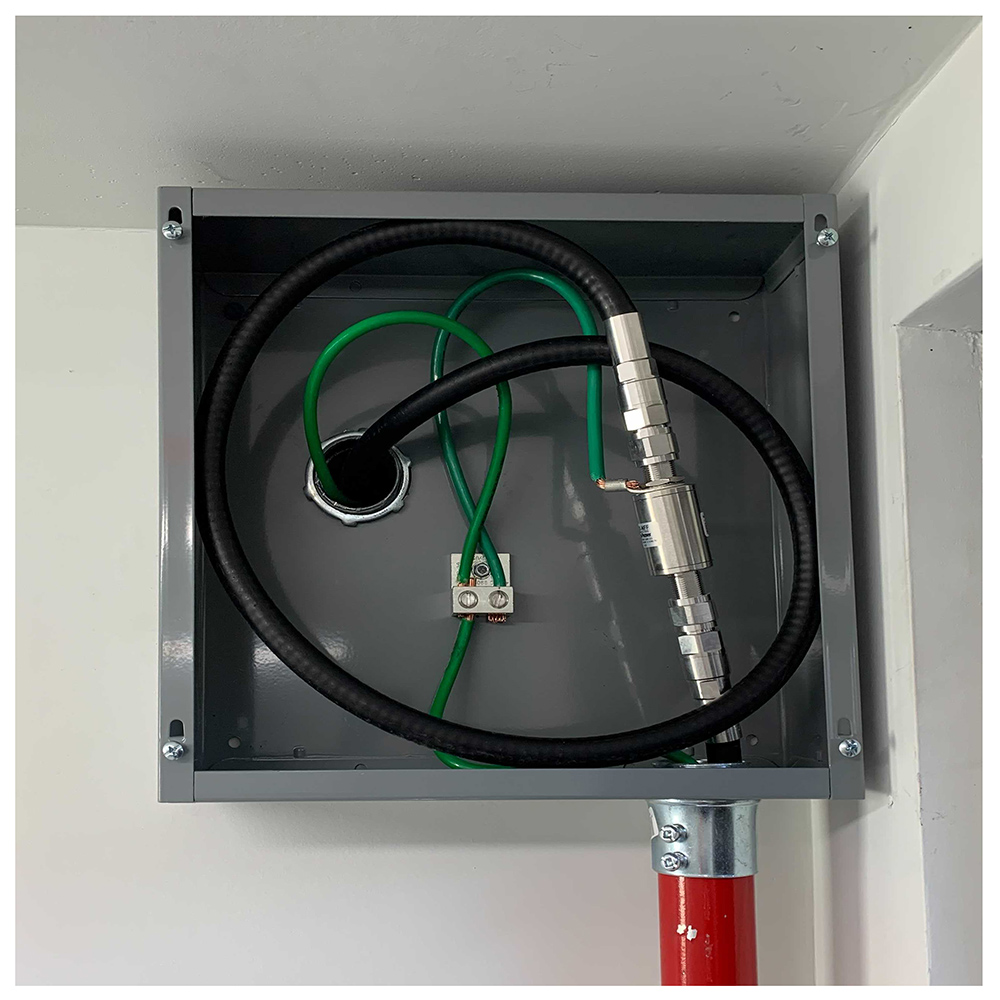
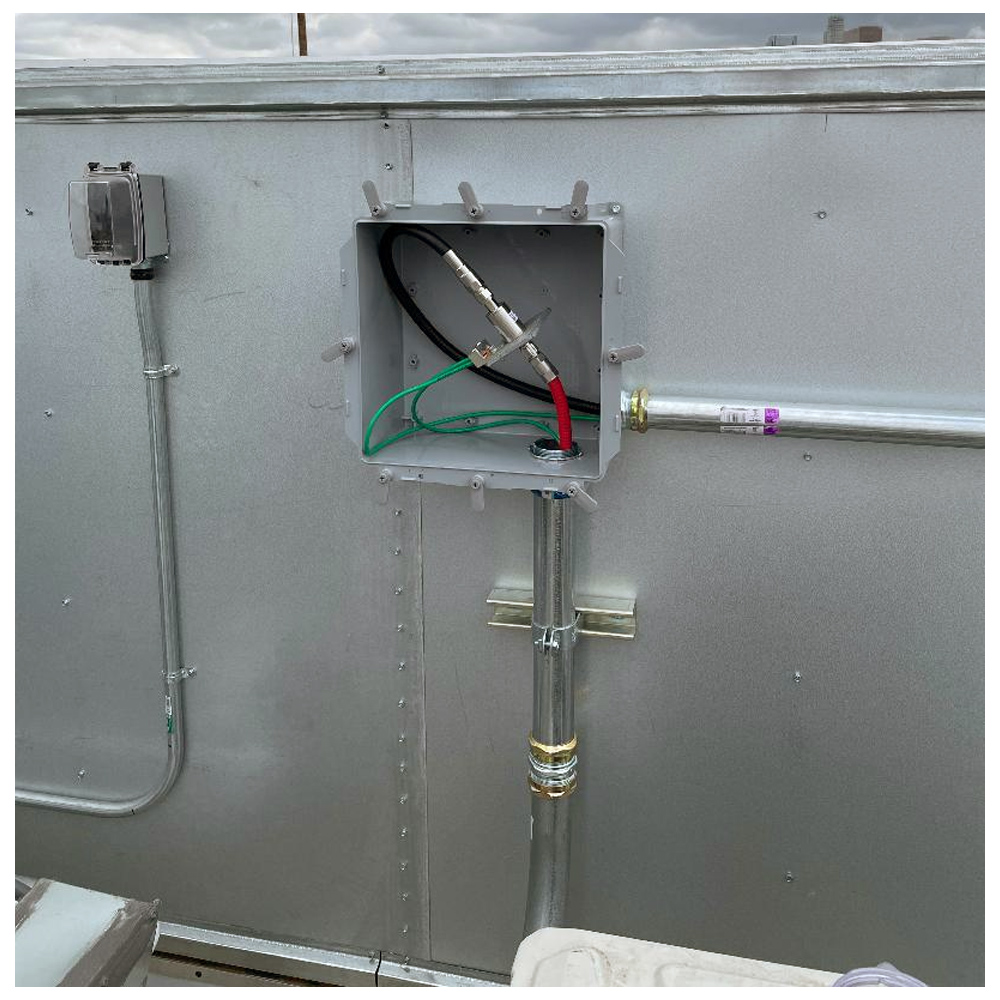
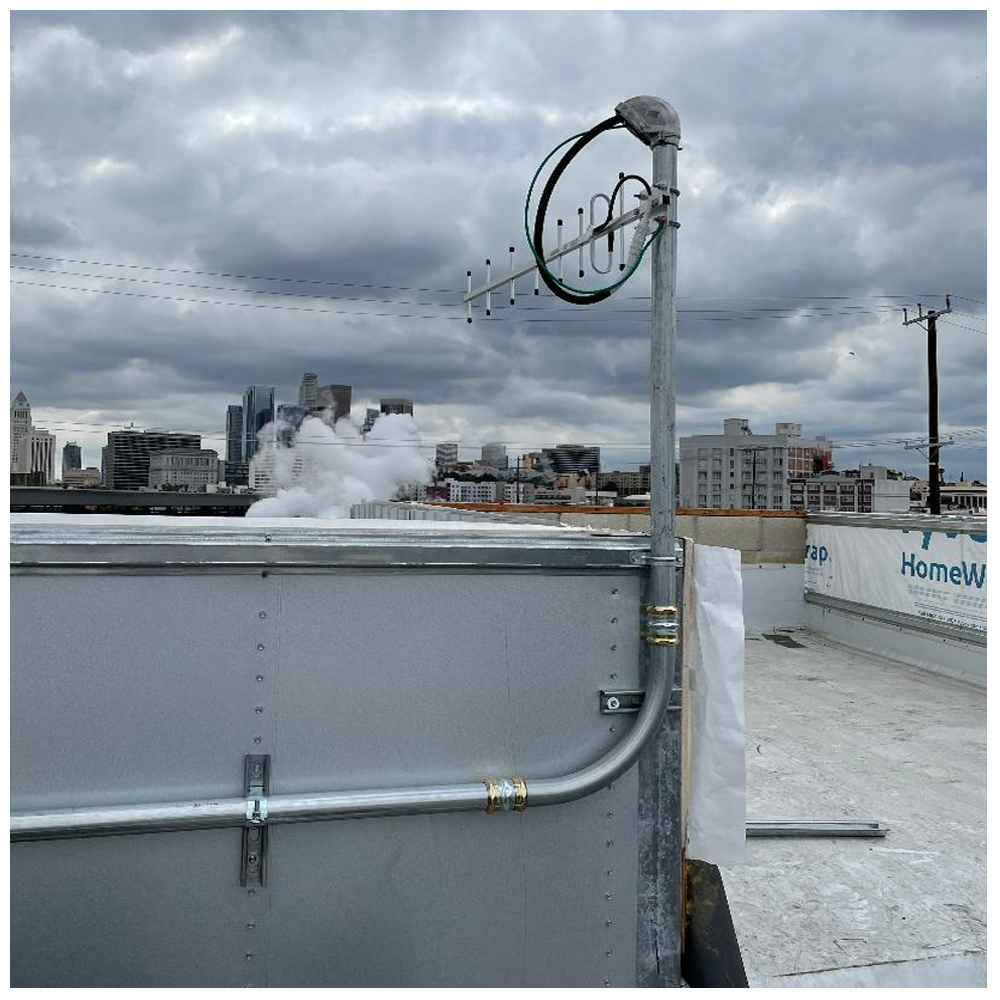
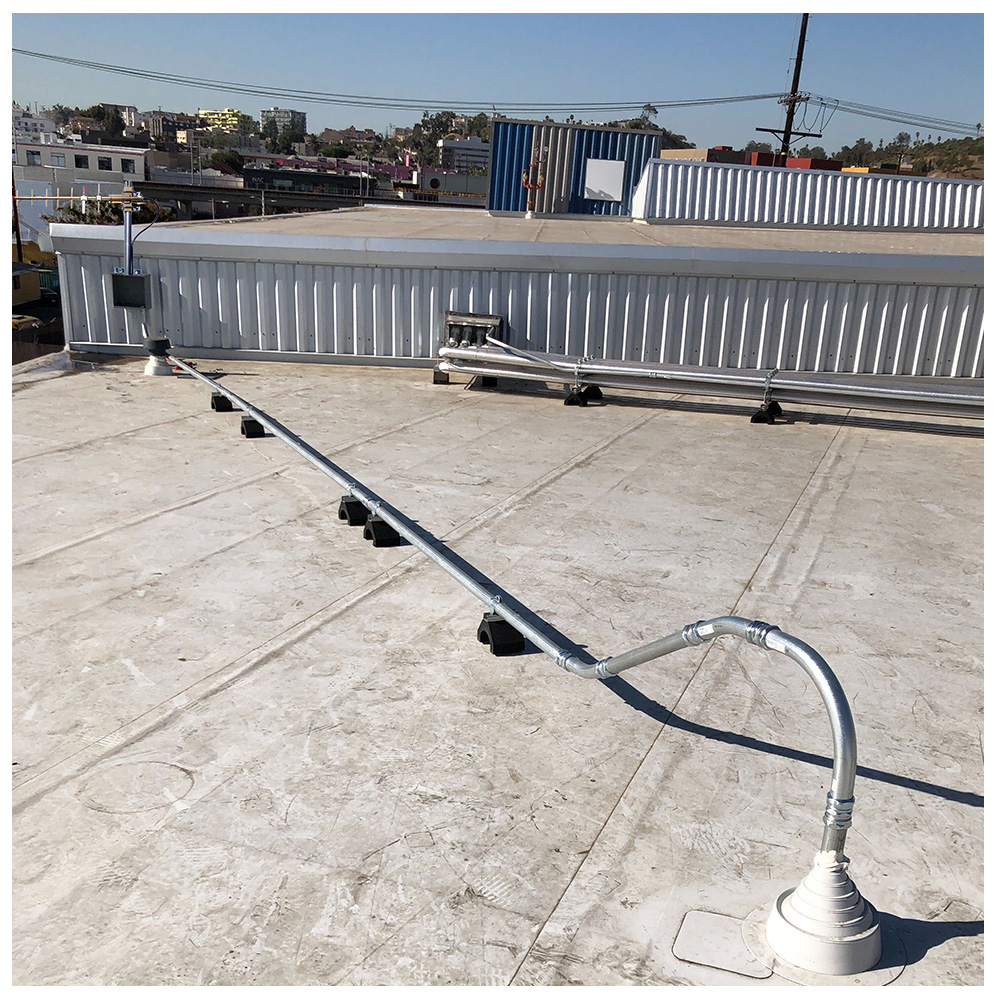
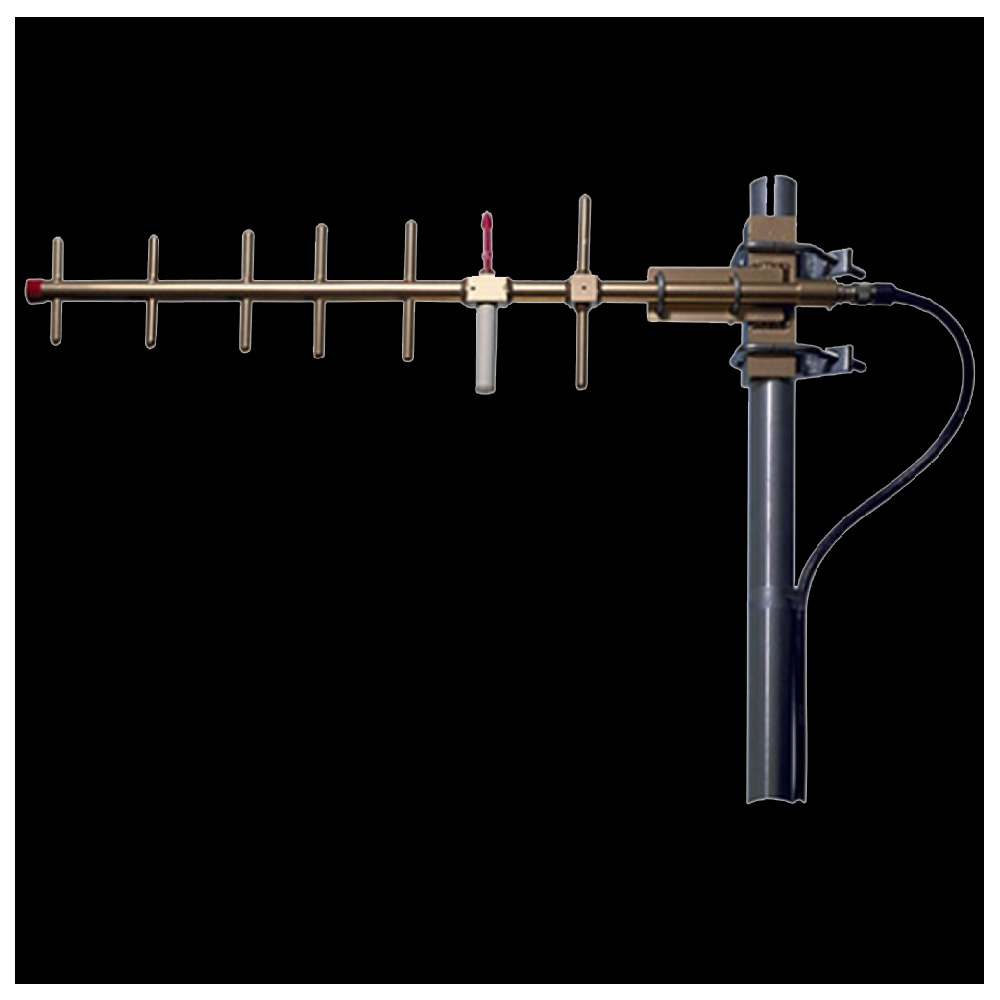
Below photos illustrate the roof-top portion of the vertical pathway with all its components and leading finally to a typical Yagi antenna to be installed on the rooftop. First row, left photo is a junction box where a lightning arrester is installed before pathway leaves the interior space to reach the roof-top; the middle photo shows the same provision when it is installed on the rooftop in a water-tight rated junction box. The right photo is the end of the vertical pathway leading to the Yagi antenna pointed at the city’s broadcast provisions.
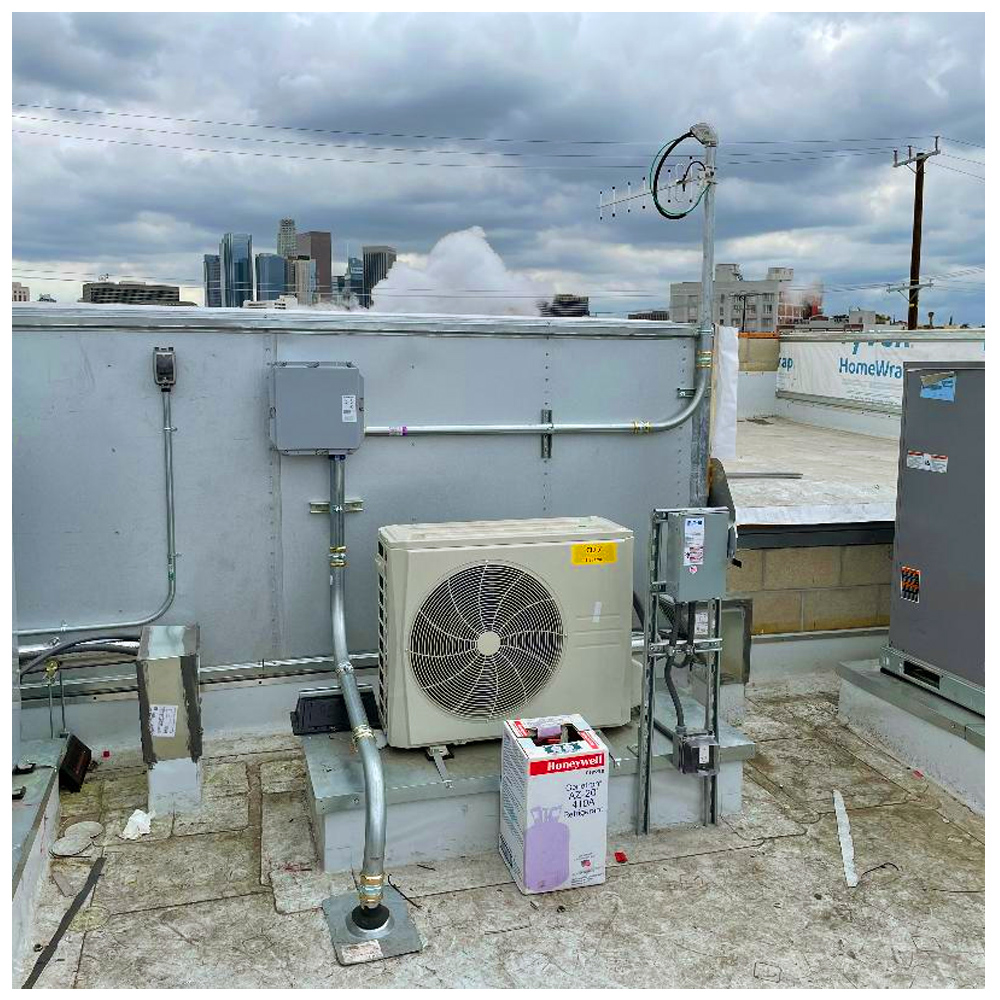
Second row left photo shows the entire pathway from penetration point to the lightening arrester junction box and the yagi antenna at the end of it. The middle picture shows a longer pathway lifted slightly off the roof-top. Note that ideally this segment of the vertical riser needs to be kept to a minimum as the entire length from the rooftop to the head-end should ideally be kept under 120 feet. The last photo on the right shows a typical yagi antenna knows in DAS as the donor.
Horizontal Pathway
- Horizontal Pathway is defined as all wiring from head-end Closet to all interior space provisions; namely, antennas, splitters, junction points, patch cables, and connections to slave units).
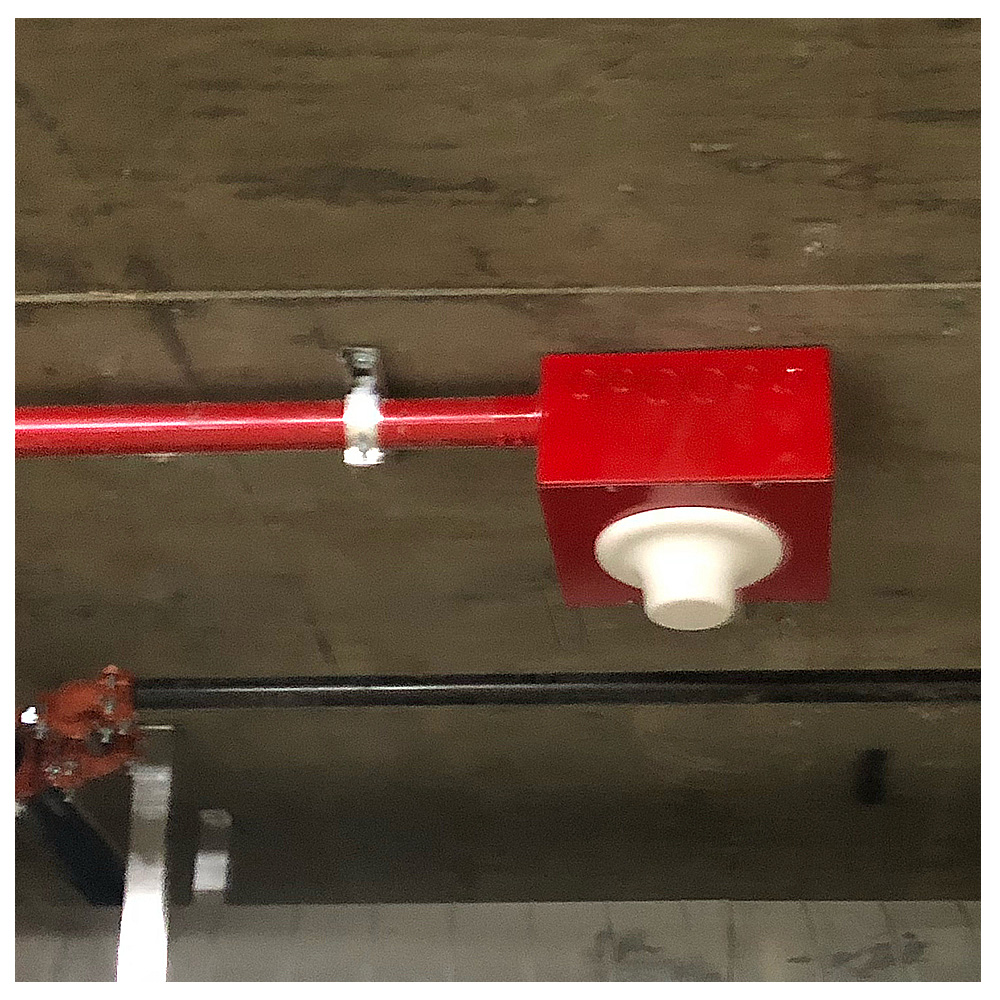
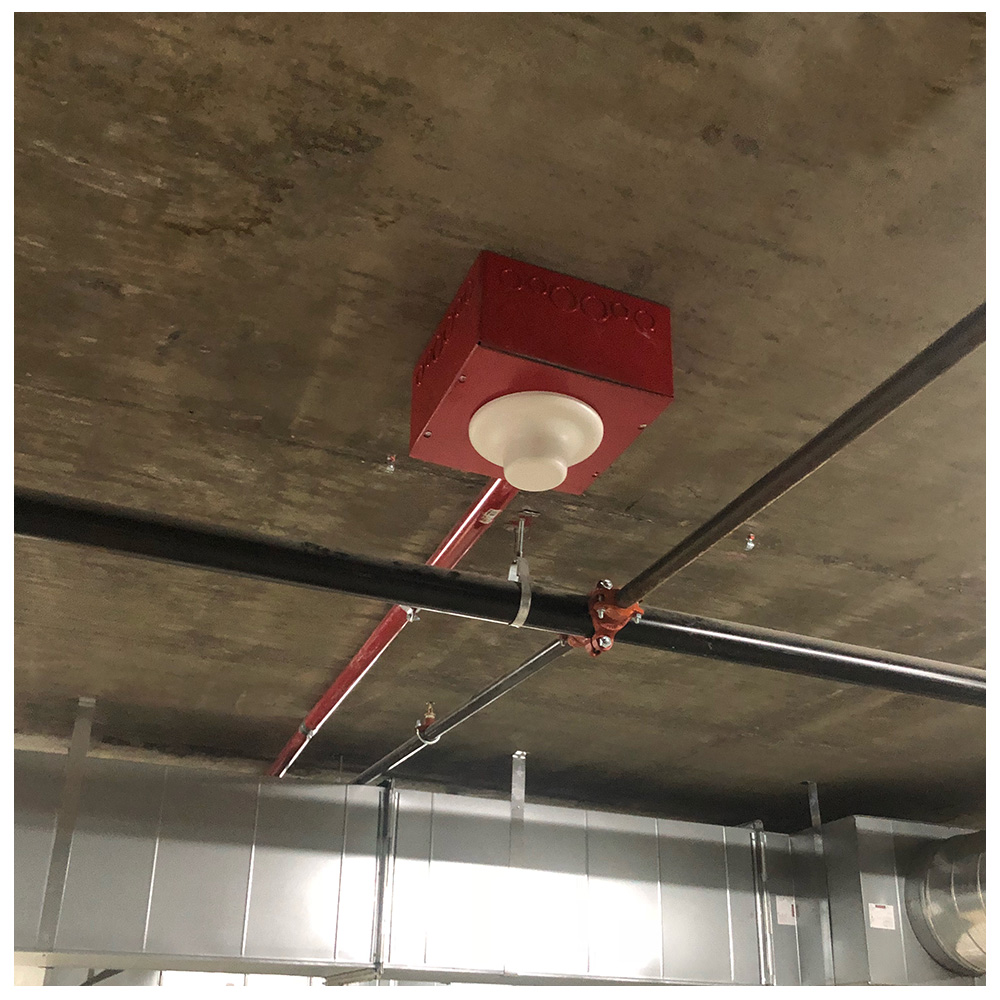
- All Wiring from head-end on garage levels needs to be in EMT Conduit (see top two photos on the right). Some LA inspectors used to insist on all EMT and junction boxes to be red which is why the two photos provided show Red EMT & painted Junctions boxes. However currently regular EMT and junction boxes are accepted as long as red “ERRCS” Stickers are adhered to all junction boxes and EMT conduit [every five feet].
- All vertical penetration points from a rated space into a non-rated space or into garage open ceiling need to enclosed within a NEMA-4X rated junction or within builder provided 2-hour assembly.
- Wiring to antennas on residential or office levels need not be in conduit in the City of Los Angeles if enclosed in ceiling assembly. (see two lower photos).
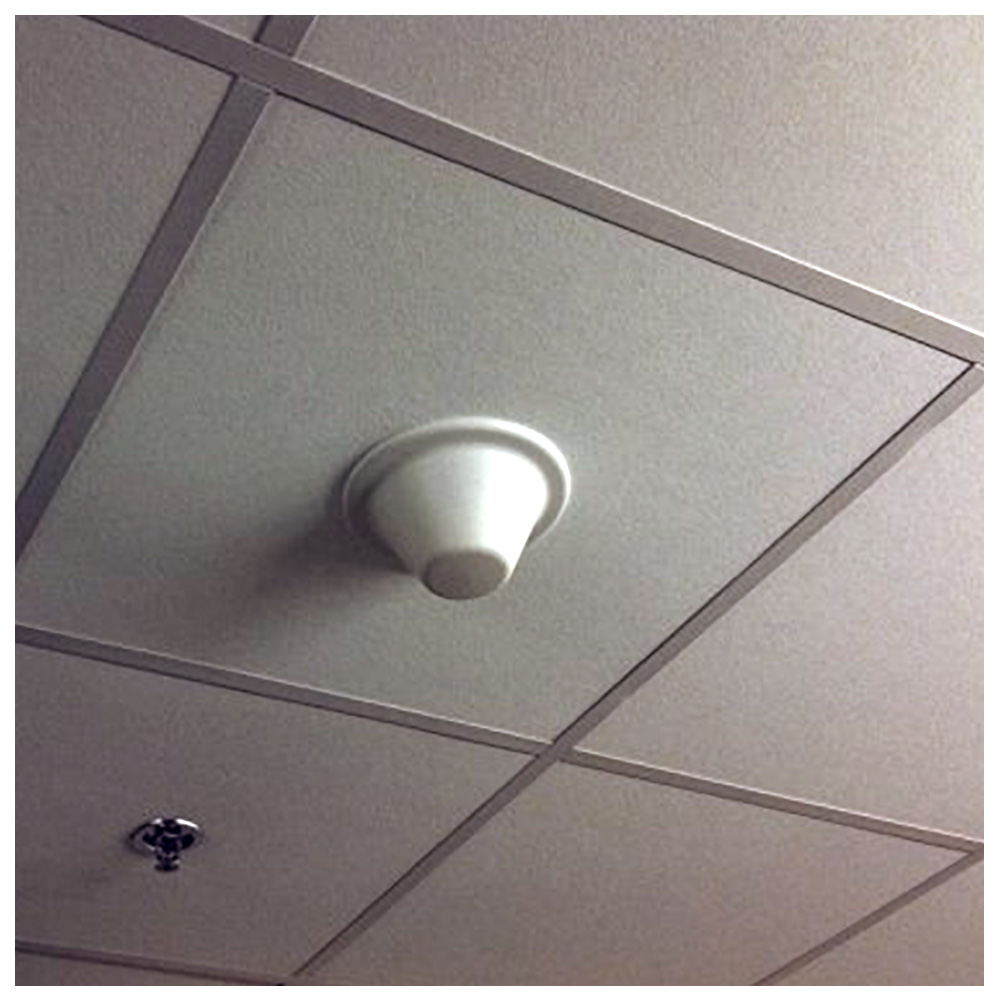
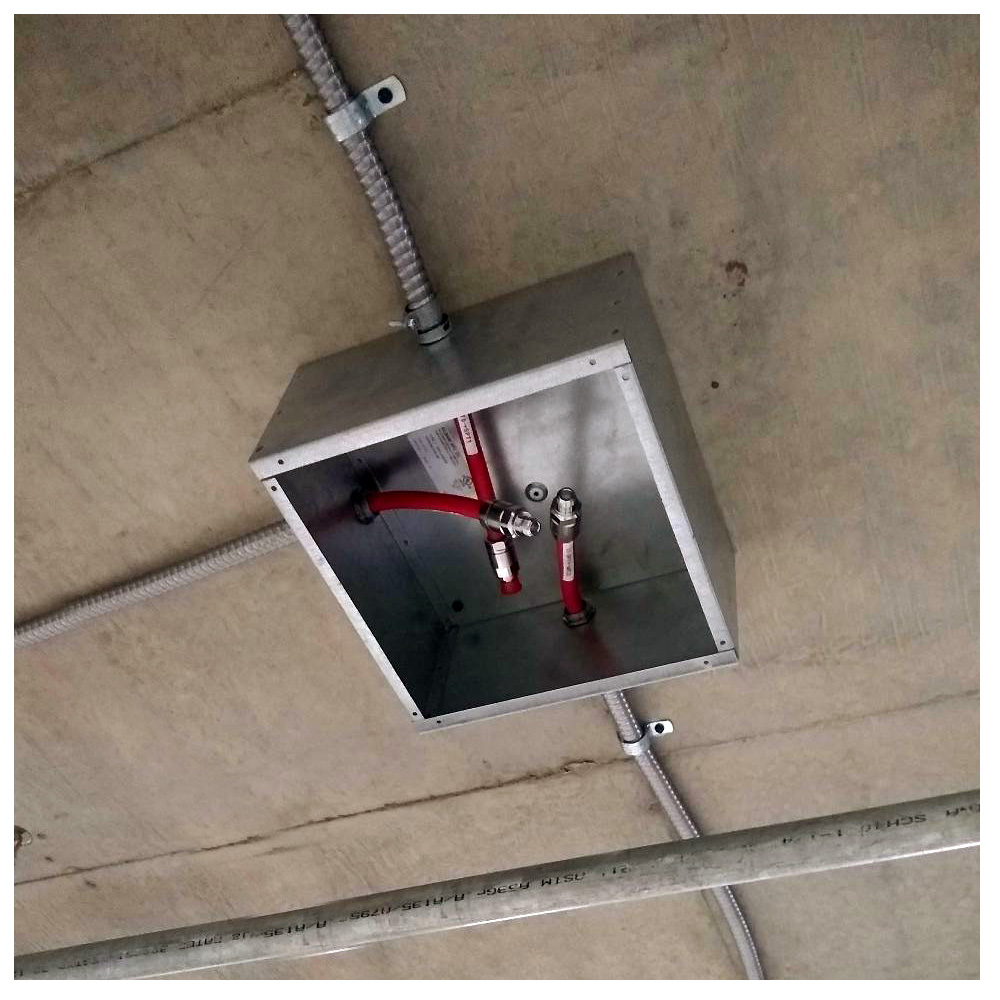
DAS Head-End Closet & Wall Space
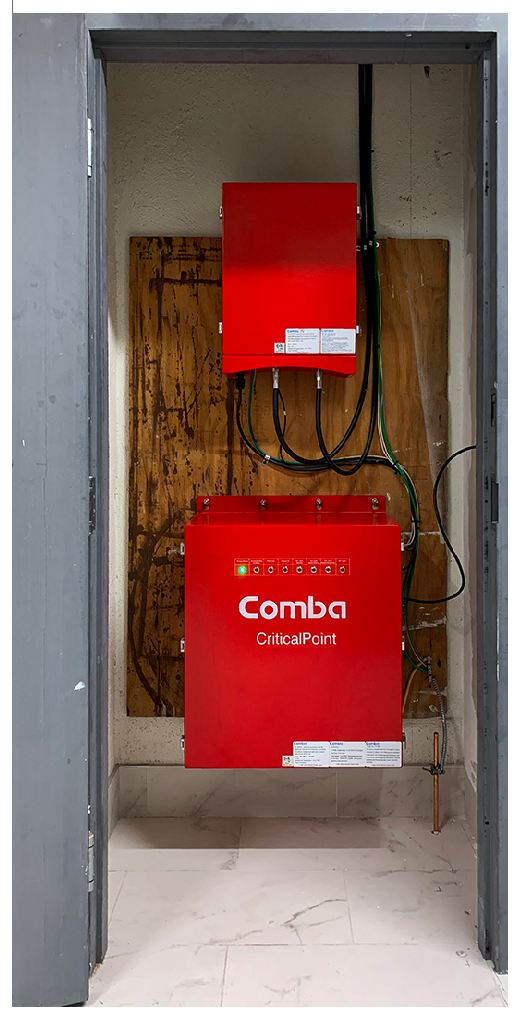
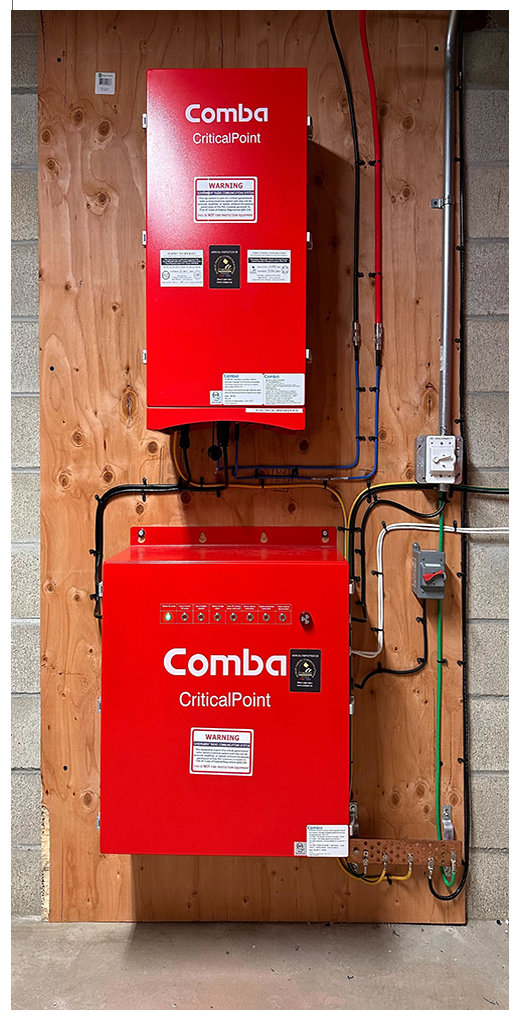
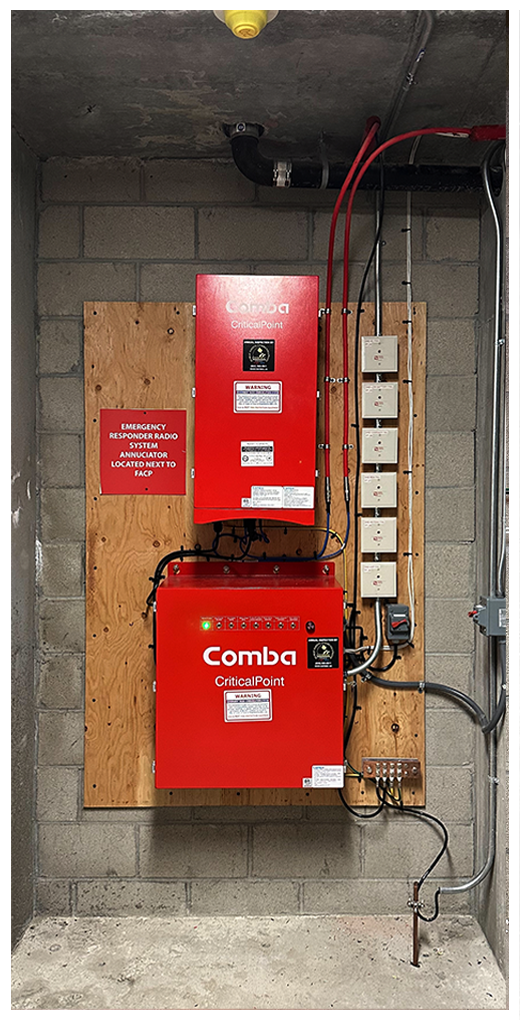
- A modest size building (single building under 350K SF) will require a wall space measuring 42″W x 20”D, clear floor to ceiling, at head-end (DAS Closet). A larger building, especially in multi-building venues, may require a larger space and/or a rack with fiber provisions. It may also feature a secondary DAS closet with a slave unit. Some municipalities may require coverage with additional rare frequencies that will require a secondary set of provisions and some may even require a floor standing filtering systems that combined will require a larger space and additional power provisions. The last two photos illustrate such a system.
- Choice of head-end location should minimize wiring distance to roof-top antenna (ideally under 120 Feet). A head-end location in a stacked IDF (or close to it) that extends all the way to the roof-top would be the most practical in most cases. Once your DAS vendor decides where the roof-top antenna is to be, the IDF stack closest to that location will serve best for the verticals.
- Head-end requires a dedicated power circuit with dedicated ground it own EPO lockout in most cities.
- A DAS closet should include a sprinkler system and smoke detector, even though some inspectors may not be aware of this requirement or enforce it. This typically is NOT included in the DAS vendor’s bid as the vendor may consider that to be outside his scope.
- For monitoring purposes, a Public Safety DAS must be linked to the fire alarm panel and a separate annunciator (provided by DAS vendor) in order to send communication in case of failures. The provision is required by most LA County AHJ and will eventually be adopted everywhere.
- The NFPA and IFC mandate that all equipment for public safety must be in enclosed in a NEMA-4X enclosure. That applies to both the radio unit and its backup power unit. Radio and power backup units bearing a UL-2524 listing meet this requirement. Make sure your DAS vendor is meeting this requirement.
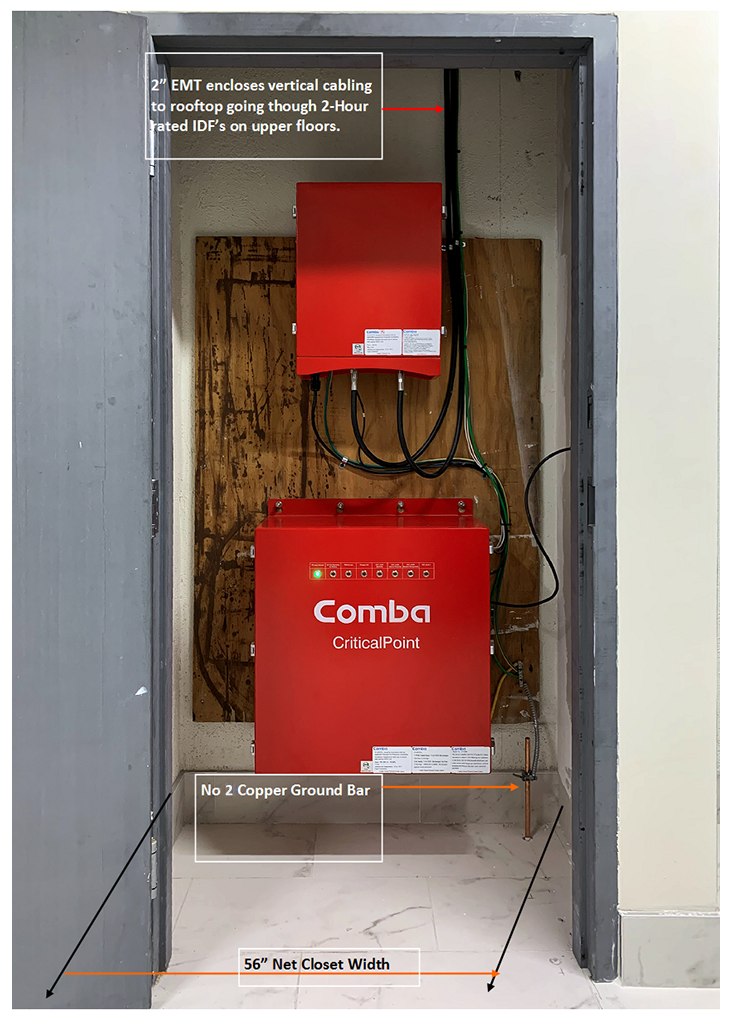
Below Photos are head-end wall spaces from three projects. First row Left Photo shows a DAS closet built by GC to meet 2-hour rating for the space. The others photos show wall spaces allocated in a larger existing 2-Hour rated room. The last row of photos shows two larger DAS system with multiple radio and filtering system.
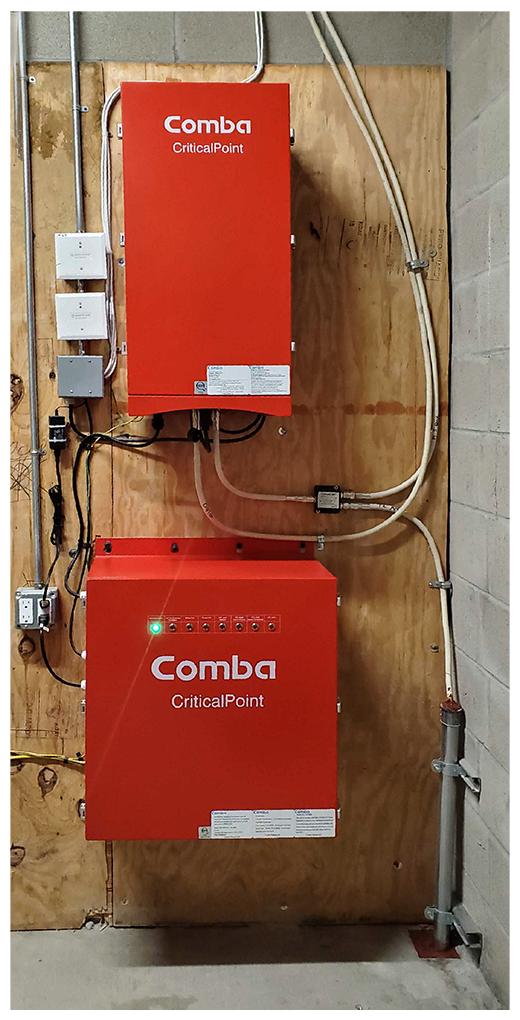
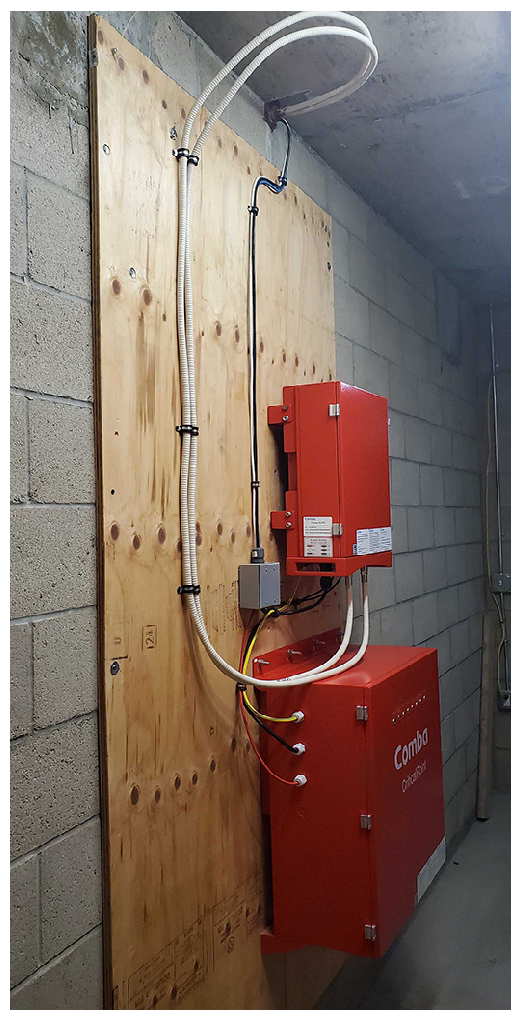
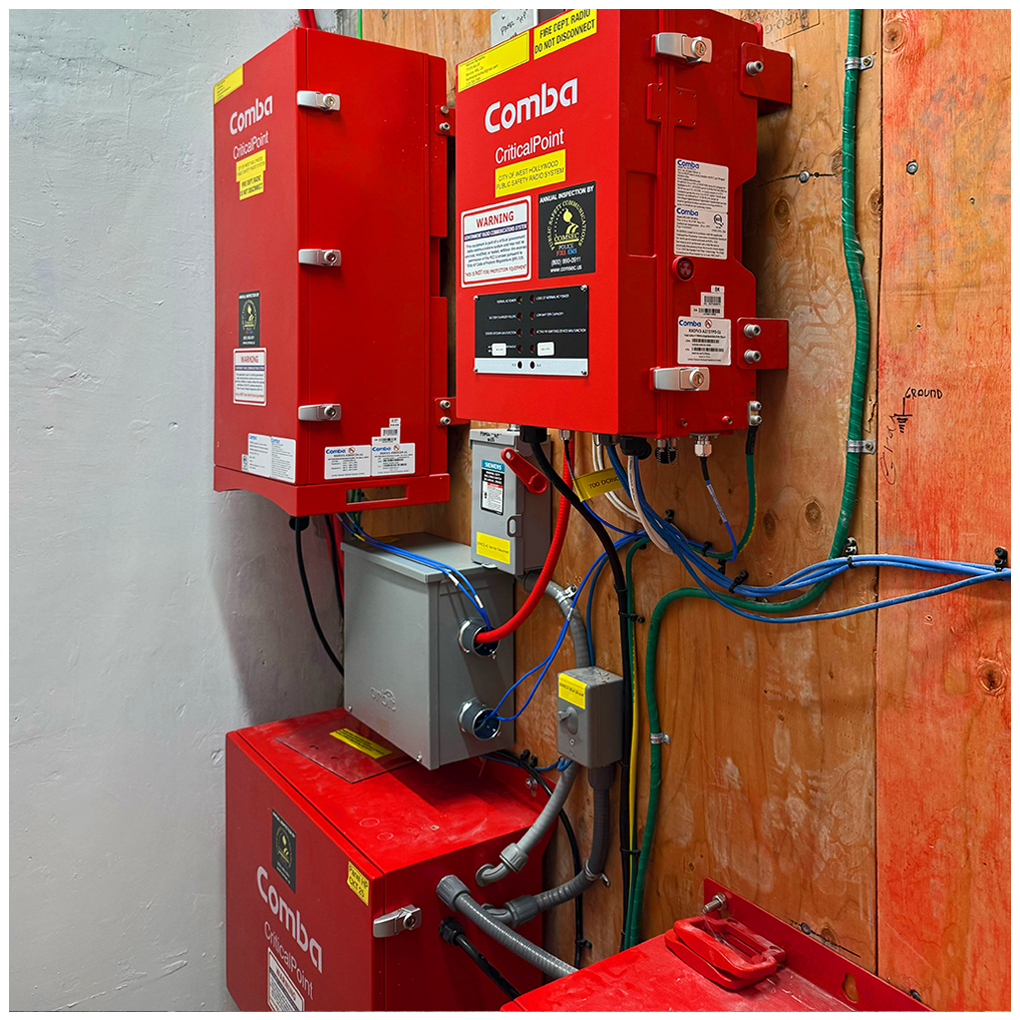
- The illustration to the right offers details on a DAS closet sectioned off from a much larger 2-hour rated room. This is a DAS system for a project with slightly under 150,000 SF or residential/office/ retail space, and as such the system is unlikely to generate any amount of heat to be of concern. This DAS closet therefore is not vented.
- The dimensions shown represent reasonable specs for a DAS system closet.
- Much larger venues, in particular those with multiple buildings in one property, are likely to have a master DAS closet and multiple secondary head-ends, all interconnected via a fiber network. Therefore a large property or one composed of multiple buildings will requires multiple instances of DAS closets, each having to meet the same specs.
- Typically the best location for a DAS closet is on a garage level, since it is not only closest to the conduit pathways on garage levels but also because it is likely to allocate a space that already is 2-hour rated.
- In choosing this space, it is best to designate an area that offers the most direct vertical pathway to the roof-top, thereby eliminating the length of pathway that must be enclosed in a 2-hour
- rated assembly. A 2-Hour rated IDF at a bottom of a stacked set of IDFs leading to upper most level is therefore ideal.
- Note the grounding in the city of LA can be No 6 gauge; however, most other AHJ will require a No 2 gauge.
- The closet must also feature a smoke detector and a sprinkler.
Notes on Conduit Work
All vertical penetration points from a rated space into a non-rated space or into a garage open ceiling need to go through a NEMA-4X rated junction or builder provided 2-hour assembly.
City of LA requires Red EMT conduit to enclose verticals and garage level horizontals. We have seen a few rare instances in which EMT conduit was not required of other DAS vendors, but for the most part that is rare. If your project has multiple underground garage levels or is an extensive and large space, you are best advised to first consult the inspector assigned to your project to find out your particular inspector’s view on treatment of horizontal pathways on parking levels before you ask for bids or accept them.
In some cities required EMT conduit need not be red; but again your inspector’s view of it is critical. We have had a city of LA inspector that required not only Red EMT conduit but also required all junction boxes & conduit couplers in a 2300 linear feet of conduit pathway to be painted red manually.
Choosing a DAS Vendor
- DAS vendor are required to have an FCC radio license. More importantly, in other cities in Southern California the DAS vendor lead installer must have a NICET level II license and the designing engineer must have both a NICET Level 2 and a GROL License. Moreover, Fire safety vendors who elect to sell and install a Public Safety DAS frequently do not have such those licenses. A GROL license ensures that your DAS vendor understands how radio signal distribution works. A poorly deployed system can leak enough signal to disable City’s Fire Dept signal transfer. Should that be discovered by City before your final inspection, there may be repercussions for the builder and owner. We have taken over several poorly executed systems where building ownership was warned with notices of five figure fees as penalty for poor system performance.
- Does your DAS vendor have the proper tools to test his own system before having it tested by the city FD or by a third party? A suitable spectrum analyzer and signal generator can cost upwards of $50K and not all DAS vendors have them. Those tools in the hands of an FCC license holder ensure that your DAS vendor can in fact test his own system, find its weak points, and address all issues prior to having an inspection by the FD or a third party (as required by some AHJ) whom you have to pay for that service.
- Has your vendor actually dealt with inspectors in the city where your project is? Note that there are significant differences between requirements by each AHJ in Public Safety DAS as well as differences in how likely they are to enforce them.
Accepting Bids
- Is the bid you are accepting in compliance with the latest city mandates and current frequencies? Note, these requirements are frequently changing. City of LA, for example, plans to require coverage of not only Fire Dept signals but also Police Dept signals at some point in the future, perhaps as early as 2027. You need to know if the radio provided (the most expensive part of the system) is dual band or up-gradable to meet those requirements. A single band radio may need to be removed altogether if that mandate is adopted during construction and the inspector applies it to your project.
- Even the smallest of Public Safety DAS quotes should ideally list dozens of line items detailing the class and UL rating of both the radio and its power supply, the number of antennas, linear feet of indoor and outdoor cables used, jumper cables, and linear feet of conduit work provided and type of enclosures to be used in the garage space.
- Does the bid you are accepting include all infrastructure costs (conduit work) and does it stipulate the type of conduit used? We have seen projects delivered by Fire safety vendors who included only PVC conduit which was rejected by city inspector. Does it include fire-caulking? Does it include lift devices if required?
- Is the bid inclusive of design fees and if so does it include cost of any design modification due to architectural changes? Does it include cost of city design submission? Remember, in some cities that cost alone is $3000 or more. Moreover, if the DAS vendor is providing you with a DAS design, does the vendor guarantee that design will work? If design provides inadequate coverage in one or more area, will the vendor pay for the additional provisions required for bringing the coverage into compliance?
- Does the bid include cost of final inspection by a third party. Remember, in some cities, City of Glendale, Pasadena or Burbank, for example, city mandates a third party they designate to do the final inspection and test coverage, and that party may charge thousands of dollars for that final test. You should know if third party costs are included. You should know that a third party inspection and test is much more thorough because the person performing it is a radio signal expert and not a city fire inspector. If the system does not pass inspection the third party is entitled to a fee for a re-test. Will your DAS vendor absorb that additional fee?
- Does the bid state that for the cost given the vendor guarantees providing adequate signal to pass inspection when the system is tested at the end? Note, if signal proves to be inadequate in one key area, due to design not having had all variables impacting signal travel in that area, will the vendor offer remedy at no additional cost to you? The vendor should submit a change order only if city requirements change or if there are significant architectural changes.
Inspections
- A project manager’s first step in the planning of a Public Safety DAS should be to find out if AHJ for that project requires a third party testing for the system. This is important because third party final inspection are done by city-designated professionals who are highly trained and earn the several thousand dollars they charge for this service and report by doing a thorough test. That alone makes your choice of whom to hire even more critical. Not all cities require this but cities with smaller fire departments are very likely to require that.
- Make sure your vendor plans a pre-inspection of the head-end space and the vertical pathway before you close framing. Inspectors see this space differently: some will examine it minimally while some are so specific that they may take an issue with the gauge of ground wire used for the power outlet in this DAS closet. A pre-inspection will tell you a lot about the inspector’s expectations and avoids later delays.
- Be present when your DAS vendor meets an electrical or Fire Dept inspector, especially in the final inspection where your Certificate of Occupancy is at stake. If corrections are required in any inspection, you will want to know firsthand from the inspector if the correction is due to an over-sight by the vendor or if it is because of a recent change in requirement or that inspector’s unique view of an aspect of the codes.
- Make sure your final inspection is well ahead of the fire dept test. We have never failed an inspection by the Fire Department but we know from their comments in our meetings how often DAS vendors fail their first and even second tests.
- Ask your DAS vendor if he plans to do a test run before the fire department test. Fire Departments may not retest your project right away if you do not pass an inspection.
- Make sure the fire vendor has integrated his system with your DAS vendors via an annunciator, if your AHJ requires an annunciator. Verify this has been done before the fire dept final is arranged.
Perils of Using Fire Safety Vendors to Do Public Safety DAS Work
Just about every two weeks we get a call from a builder or developer telling us they would like our services in checking an existing DAS system that has not passed inspections for a long time and the installer is unable to finish it. A few minutes into the conversation, we have confirmation once again that the DAS system was installed by a Fire Safety vendor.
Builders cannot be entirely faulted for thinking that a fire safety vendor is well-suited to the task of providing a DAS system. After all, requirements for both systems are enshrined within California Fire code and that probably is true across the nation. However, the underlying technology for a DAS system is entirely a different science: it requires understanding radio signals and how each band of frequencies behaves; it requires complex math in understanding of device outputs & values; and it requires understanding of signal loss and specific techniques to avoid it. Most importantly, it requires exotic gear to be able to test and measure outputs to ensure provided signal is not only enough but also not beyond required levels, because in either case of too much signal output or too little there are liabilities for all involved. A well-equipped, genuine DAS vendor may in fact be using devices costing tens of thousands of dollars to test a DAS system. Moreover, both the designer of such a system and its installer are required by code to own FCC licenses (Grol license) as well as certification from the manufacturer of radios used in DAS systems.
The simple analogy to help understand the above distinction is this: you would not hire a Fire Safety vendor to provide you with a Commercial WiFi system: a WiFi system conceptually is similar to a DAS system because in both cases a specific signal for communication is acquired (Internet service for WiFi or Radio Signal from Fire Department in a DAS system) and are broadcast across areas where connectivity for communication is required. And yet, for all the important reasons below, you would have far less liability if you were to have a Fire Safety Vendor install a WiFi system for you rather than a DAS system:
- Degree of coverage by a WiFi system is not as critical and is not specifically mandated: for a DAS system, by code all common area of a building need to have 95 percent coverage and critical pathways need to have 99 percent coverage; otherwise you will not pass inspection. In some AHJ, Pasadena, Glendale, Culver City, West Hollywood and adjacent communities, for example, very knowledgeable third party inspectors will test a DAS system and verify extent and strength of coverage.
- WiFi systems universally receive the same signal to connect to the web and behave the same way regardless of their performance level; whereas frequencies used by a DAS system vary from city to city and different frequencies have entirely different propagation properties with anomalies associated with specific bands. An installer has to understand behavior of different bands and work around limitations and anomalies each band represents. This means understanding radio science.
- Most importantly, too much signal is NOT an issue in a WiFi system. If WiFi signal extends beyond your building, it will not have much/any impact on WiFi in a neighboring property. When looking for WiFi signal, we all frequently see multiple WiFi options with strength present in the same location. A DAS system leaking signal out of your building is in violation of FCC, State and City statutes because frequencies used for DAS systems travel far and can be acquired by another building’s DAS antenna, causing various forms of failure in other DAS systems. There is a $30K penalty levied by the FCC if it were to discover that a DAS system in your building is leaking signal to nearby areas.
So far, Fire Safety vendors in the city of Los Angeles have been able to pass inspections by propagating too much signal to ensure passing their inspection. An LA fire inspector is not an engineer and he is equipped with only a radio for his final inspection. If he sees good connection with the Fire Dept HQ, he is satisfied there is adequate signal & pass the vendor in that inspection; what he cannot know is that the same DAS system is pushing that signal hundreds of feet away also. Therefore, the third bullet point above merits a much longer discussion, but at a minimum you need to realize that an improperly installed DAS (ERRCS) installed in your can have a disabling effect on the DAS systems nearby and/or on the entire city- or county-wide radio network in a variety of ways too technical to detail here. By putting plenty of signal through his system in your building, a Fire Safety DAS vendor will pass inspection conducted within the building, but the signal leaking outside the building may prevent fire department officers showing up in a nearby building from connecting to their base and exchanging critically important messages.
Moreover, that signal leakage may not be discovered for some time because currently too few buildings exist with a DAS system since the mandate is fairly new. However, as soon another building is erected nearby, the second DAS system will have either too much noise in the system or no capacity to communicate despite its DAS vendor’s correct deployment. The second DAS vendor will eventually figure out that the problem in their system is signal leakage from a nearby building and a casual look in the neighborhood will identify the building with the offending DAS system; he will have no choice but to inform the agencies involved because he cannot pass inspection on his system as long as the DAS system in your building is active and is leaking signal.
That discovery point may be one or two years away from the time your Fire Safety vendor has passed inspection in your project, but as more DAS systems are deployed in the area, it will eventually come. We will put aside all other liabilities when that moment of discovery comes, but consider that at a minimum fixing the offending DAS systems’ output is a very large undertaking. Few competent DAS vendors are willing to undertake the task of correcting such a DAS system because they have to provide you with only extensive labor to redesign and/or troubleshoot the system and limit signal to what is required.
Currently most cities are using a third party inspector to test performance of these DAS systems exactly for all the above reasons. These inspectors will first verify if the installer is actually properly licensed and secondly if the system deployed is working properly. In fact, most AHJ, other than City of LA and Santa Monica, are requiring to see a design submission to verify credentials of the installer. That safety measure still does NOT exist in the city of LA and therefore Fire Safety vendors who do not understand radio science are able to get systems sold and deployed in the City of LA. They are able to beat estimates from the more experienced and knowledgeable DAS installers since they are doing both Fire Safety and DAS system; they may often pass inspection by flooding the building with too much signal; but in the end, the unknown issues they leave behind will be a liability awaiting eventual discovery in what is a life safety system and regulated by all levels of government.
Disclaimers
We have created this page as a reference for all the fellow project managers we work with; but its content is not to be taken as a substitute for a given AHJ’s requirements. We do our best to keep this updated, but as public safety is a fast evolving provision, some of the information may not be the most current. Also, the largest variable in this provision is that inspectors vary widely in how they interpret the code and how forcefully they enforce them. As such, we would like this page to serve as an orientation; but we take no responsibility for the content of this page or its accuracy or any issues that may arise from an AHJ disputing parts of this content.
Call Us: (310) 277 - 4567
31348 Via Colinas - Unit 103, Westlake Village, CA 91362